When I first decided to learn cyber security, I quickly realized that the internet was full of tutorials, videos, and online courses. While those resources were helpful, I also discovered that books offered something different. A good cyber security book explains concepts in a structured way, helping me build a strong foundation instead of jumping randomly from one topic to another.
Many beginners believe they need expensive certifications or advanced technical skills before reading cyber security books. In my experience, that is not true at all. The right beginner friendly books can teach everything from basic networking to ethical hacking and digital security in a simple and understandable way.
In this article, I will share some of the best cyber security books for beginners that I believe are worth reading. These books helped me understand important concepts, improve my knowledge, and build confidence step by step.
Why Beginners Should Read Cyber Security Books
One thing I noticed while learning cyber security is that videos often focus on showing how to do something, but books explain why it works. Understanding the reasons behind security concepts is just as important as learning practical skills.
Books also allow me to learn at my own pace. I can reread difficult chapters, highlight important points, and take notes whenever I need. Unlike short online videos, books provide complete explanations without skipping important details.
Another advantage is that books are written by experienced professionals who have spent years working in the cyber security industry. Their real world knowledge makes learning much more practical.
What Makes a Good Cyber Security Book
Not every cyber security book is suitable for beginners. Some books assume that readers already understand programming, networking, or operating systems.
When choosing my first books, I looked for several qualities.
The language should be simple and easy to understand.
The examples should be practical instead of overly technical.
The book should explain basic concepts before introducing advanced topics.
It should include real world scenarios that help connect theory with practical applications.
A beginner friendly book should also encourage curiosity rather than making readers feel overwhelmed.
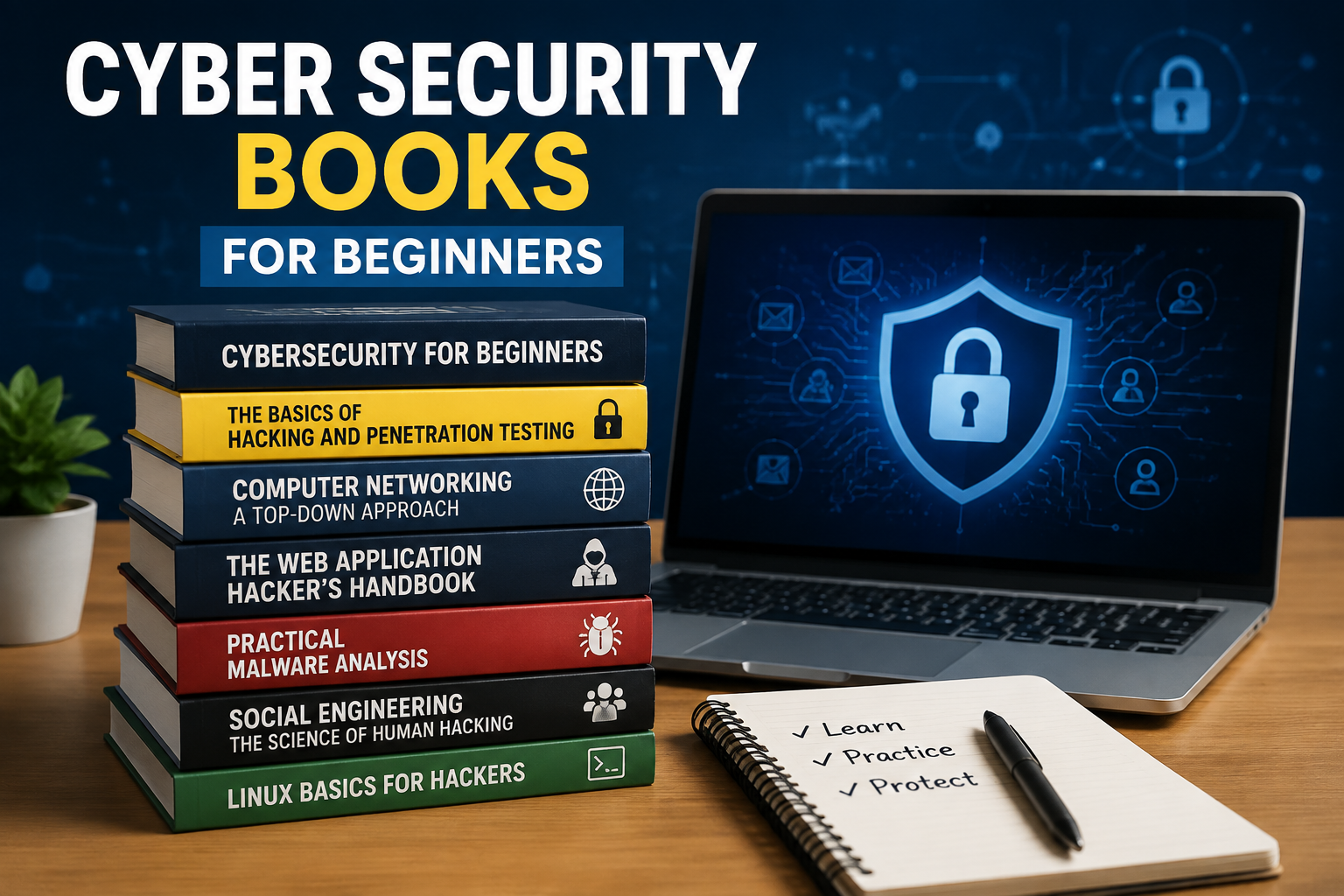
Cybersecurity for Beginners by Raef Meeuwisse
This was one of the easiest cyber security books I came across. The author explains technical topics in everyday language without making them sound complicated.
The book covers important topics such as cyber attacks, malware, social engineering, passwords, online privacy, and digital safety. I especially liked how every chapter included practical examples that anyone could understand.
For someone completely new to cyber security, this book provides an excellent starting point.
The Basics of Hacking and Penetration Testing by Patrick Engebretson
When I became interested in ethical hacking, this was one of the first books I wanted to read.
Instead of simply talking about hacking, the author explains the complete penetration testing process from beginning to end. The book introduces scanning, information gathering, vulnerability assessment, exploitation, and reporting in a beginner friendly manner.
Although some basic networking knowledge is helpful, the explanations remain simple enough for motivated beginners.
This book also introduces several popular security tools that are widely used in the industry today.
Practical Malware Analysis
Malware analysis may sound like an advanced topic, but understanding how malicious software works can improve overall security knowledge.
This book explains how security researchers examine viruses, ransomware, worms, and other malicious programs.
While some chapters become technical, beginners can still benefit from reading the introductory sections to understand how attackers create and distribute malware.
Even if I did not understand every technical detail during my first reading, I learned valuable concepts that became clearer over time.
Hacking The Art of Exploitation
This book is considered a classic among cyber security enthusiasts.
Unlike many beginner books, it dives deeper into programming, memory management, Linux, networking, and exploit development.
I would not recommend starting with this book if someone has absolutely no technical background. However, after learning basic networking and computer fundamentals, it becomes an excellent resource for expanding knowledge.
The author explains difficult concepts surprisingly well, making complex topics easier to understand with patience and practice.
Computer Networking A Top Down Approach
Although this is technically a networking book rather than a cyber security book, I believe every beginner should read it.
Cyber security depends heavily on networking. Without understanding how computers communicate, protecting them becomes much more difficult.
This book explains topics such as TCP, IP, DNS, HTTP, routing, wireless networks, and network protocols using clear examples and illustrations.
The knowledge gained from this book becomes useful throughout every cyber security career.
The Web Application Hacker’s Handbook
As websites continue to grow, web application security has become one of the most important areas in cyber security.
This book explains how websites work and how attackers discover vulnerabilities.
Readers learn about authentication, sessions, SQL injection, cross site scripting, file uploads, and many other common security issues.
Although it contains advanced material, beginners can still learn valuable concepts by reading the earlier chapters carefully.
Social Engineering The Science of Human Hacking
Many people assume cyber attacks always involve sophisticated hacking tools. In reality, attackers often target people instead of computers.
This book explains how cyber criminals manipulate human psychology to steal passwords, financial information, and confidential data.
Reading this book changed how I think about online security. I realized that strong technical skills alone are not enough if people can still be tricked into revealing sensitive information.
Every beginner should understand social engineering because it remains one of the most successful attack methods used today.
CompTIA Security+ Study Guide
Even if I was not planning to take the CompTIA Security+ certification exam, I found this study guide extremely valuable. It covers many of the core concepts that every cyber security beginner should know.
The book explains topics such as risk management, network security, identity management, cryptography, cloud security, incident response, and security operations. What I like most is that the information is organized in a logical order, making it easier to understand one concept before moving to the next.
Many professionals recommend this book because it builds a strong foundation that can be useful regardless of which cyber security career path someone chooses.
Linux Basics for Hackers
Almost every cyber security professional uses Linux in some way. At first, Linux looked confusing to me, but this book made the learning process much easier.
It introduces the Linux operating system, file management, networking commands, permissions, shell scripting, package management, and security basics. The explanations are written with beginners in mind, so I never felt overwhelmed while reading.
Learning Linux is one of the best investments I could make because many penetration testing tools and security utilities are designed to run on Linux systems.
Black Hat Python
After understanding the basics of cyber security, I wanted to automate simple tasks. That is where this book became useful.
It teaches Python programming from a cyber security perspective. Instead of focusing only on programming theory, it shows how Python can be used for network scanning, automation, packet analysis, and security testing.
Some programming experience is helpful, but I believe motivated beginners can still follow along by practicing the examples one chapter at a time.
How I Read Cyber Security Books
One mistake I made in the beginning was trying to finish every book as quickly as possible. Later I realized that cyber security books are not novels. They are learning resources that deserve careful attention.
Now I read one chapter at a time, take notes, highlight important concepts, and practice whatever I learn. If I do not understand something, I search for additional explanations or watch a demonstration before moving forward.
This slower approach has helped me remember concepts much better than simply reading page after page.
Should I Buy Physical Books or Digital Books
Both formats have their own advantages.
I personally enjoy physical books because I can highlight important sections, write notes in the margins, and quickly flip between chapters. Reading from paper also reduces screen time after spending hours on the computer.
Digital books are equally useful because they are portable, searchable, and often less expensive. I can carry an entire library on my tablet or laptop and access it whenever I want.
The best choice depends on personal preference. The most important thing is to actually read and apply what the book teaches.
Combine Reading with Hands On Practice
Reading alone will not make anyone a cyber security expert. The real learning begins when I apply the concepts in practice.
Whenever I finish a chapter about networking, Linux, or ethical hacking, I spend time practicing in a safe learning environment. I create virtual machines, explore Linux commands, analyze network traffic, and experiment with beginner friendly security tools.
This combination of reading and practical experience helps reinforce everything I learn.
Do Not Try to Read Everything at Once
Cyber security is a massive field that includes network security, cloud security, penetration testing, malware analysis, digital forensics, incident response, application security, and much more.
In the beginning, I felt like I needed to learn everything immediately. That only made learning more stressful.
Instead, I started with one book, completed it carefully, and then moved to the next. Over time, I noticed that each new book became easier because the previous ones had already built my foundation.
Learning slowly but consistently is much more effective than rushing through dozens of books without understanding them.
My Recommended Reading Order
If someone asked me where to start, this would be my recommended order.
Begin with Cybersecurity for Beginners to understand the fundamentals.
Next, read Computer Networking A Top Down Approach because networking knowledge is essential.
Continue with Linux Basics for Hackers to become comfortable using Linux.
After that, study The Basics of Hacking and Penetration Testing to understand ethical hacking.
Then move on to the CompTIA Security+ Study Guide for broader security concepts.
Finally, explore advanced books such as The Web Application Hacker’s Handbook, Practical Malware Analysis, Black Hat Python, and Hacking The Art of Exploitation as your skills improve.
Following this progression makes learning feel natural instead of overwhelming.
Final Thoughts
Looking back, reading cyber security books was one of the smartest decisions I made during my learning journey. Online courses and videos are excellent for demonstrations, but books helped me understand the theory, terminology, and mindset behind cyber security. They gave me the confidence to explore new topics and solve problems with a deeper understanding.
If you are just beginning, do not worry about becoming an expert overnight. Choose one beginner friendly book, read it carefully, take notes, and practice what you learn. Every chapter will strengthen your knowledge, and every book will bring you one step closer to becoming a skilled cyber security professional.
Cyber security is a field that rewards curiosity and continuous learning. Technology changes every day, and new threats appear all the time. By making reading a regular habit, you will stay informed, improve your skills, and build a strong foundation for a successful career in cyber security. Every expert was once a beginner, and the journey starts with opening the first book and taking that first step.